THE PEOPLES WATER FORUM
Side Events: 2023 UN Water Conference
Scroll down for a full list of PWF, affiliated and recommended events
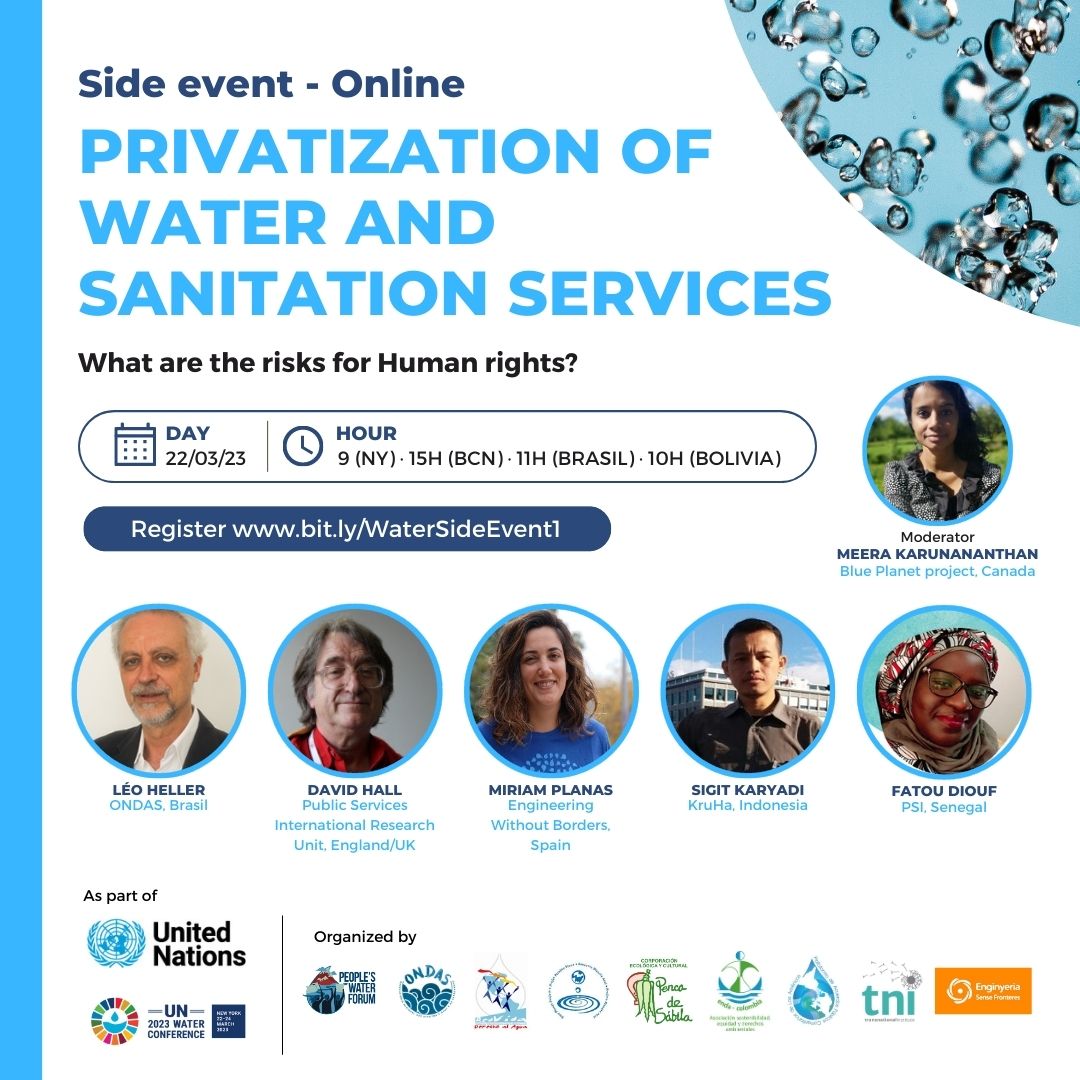
Privatization of Water and Sanitation Services: What are the risks for Human rights?
Private sector participation in the provision of water and sanitation services has been promoted for decades as a way to improve universal access to services and attract investment to the sector. More recently, a change in the models in which this participation is promoted has been observed, with the introduction of different modalities of marketization, financialization, concessions, BOTs, outsourcing and public-private partnerships, along with the full divestment model implemented in a few countries. Currently, the combined agenda of SDG 6 and SDG 17 has guided strategies and calls for strengthening the role of the private sector in water services, but this is often done uncritically and without assessing the potential impacts of these strategies on the realization of the human rights to water and sanitation.
With almost 40 years of experience following the introduction of the private sector in the water sector in the contemporary era, it is time to take stock of the situation and trends and learn lessons that can inform policies to be promoted especially in the second half of the 2030 Agenda.
Different challenges need to be addressed in this assessment:
Does the substitution of public provision by private provision result in more efficiency? How do we define efficiency in this evaluation? Economic efficiency? For whom? Social efficiency? For whom? Does private provision guarantee better access? Access for more people? Who is included and who is excluded from access? Are the needs of children, older people, and people with disabilities taken into account? How is access for people living or working in public spaces considered in these experiences? How is accessibility taken into account in these situations? In general, has the quality of services improved? How is the quality of drinking water progressing? What about surface and groundwater quality? What are the links to public health?
A related discussion is the growing trend of remunicipalization of water services observed in many countries. How rational are these processes? How can they teach us about the failures of private sector participation? How can regulation and social participation be improved, ensuring the alignment of private providers with the human rights framework?
This side event will aim to provide answers to these and other related questions about the privatization of water and sanitation services, in order to provide input for the discussion that will take place at the Water Conference.
Moderator: Meera Karunananthan, Blue Planet Project, Canada
Speakers:
- Leo Heller, ONDAS, Brazil
- Fatou Diouf, PSI, Senegal
- David Hall, PSIRU, UK
- Miriam Planas, ISF, Spain
- Sigit Karyadi, KruHa, Indonesia
Organizer by:
ONDAS, RED VIDA, BPP, PENCA DE SABILA, PAPC, ENDA, TNI and ISF
Date and time:
22 March 2023
9AM, EST
Register
- Leandro del Moral, Fundación Nueva Cultura del Agua (FNCA) Spain.
- Marcela Oliveira, Red Vigilancia Interamericana para la Defensa y Derecho al Agua (Red VIDA). Latin American network and the Blue Planet Project, Canada.
- Lina Mondragón, Corporación Ecológica y Cultural Penca De Sábila, Colombia.
- Luis Babiano, Asociación Española de operadores públicos de abastecimiento y saneamiento, Spain.
- Pablo Sánchez, European Federation of Public Service Unions (EPSU).
- Beatriz Escribano, Observatorio del agua de Terrassa (OAT), Spain.
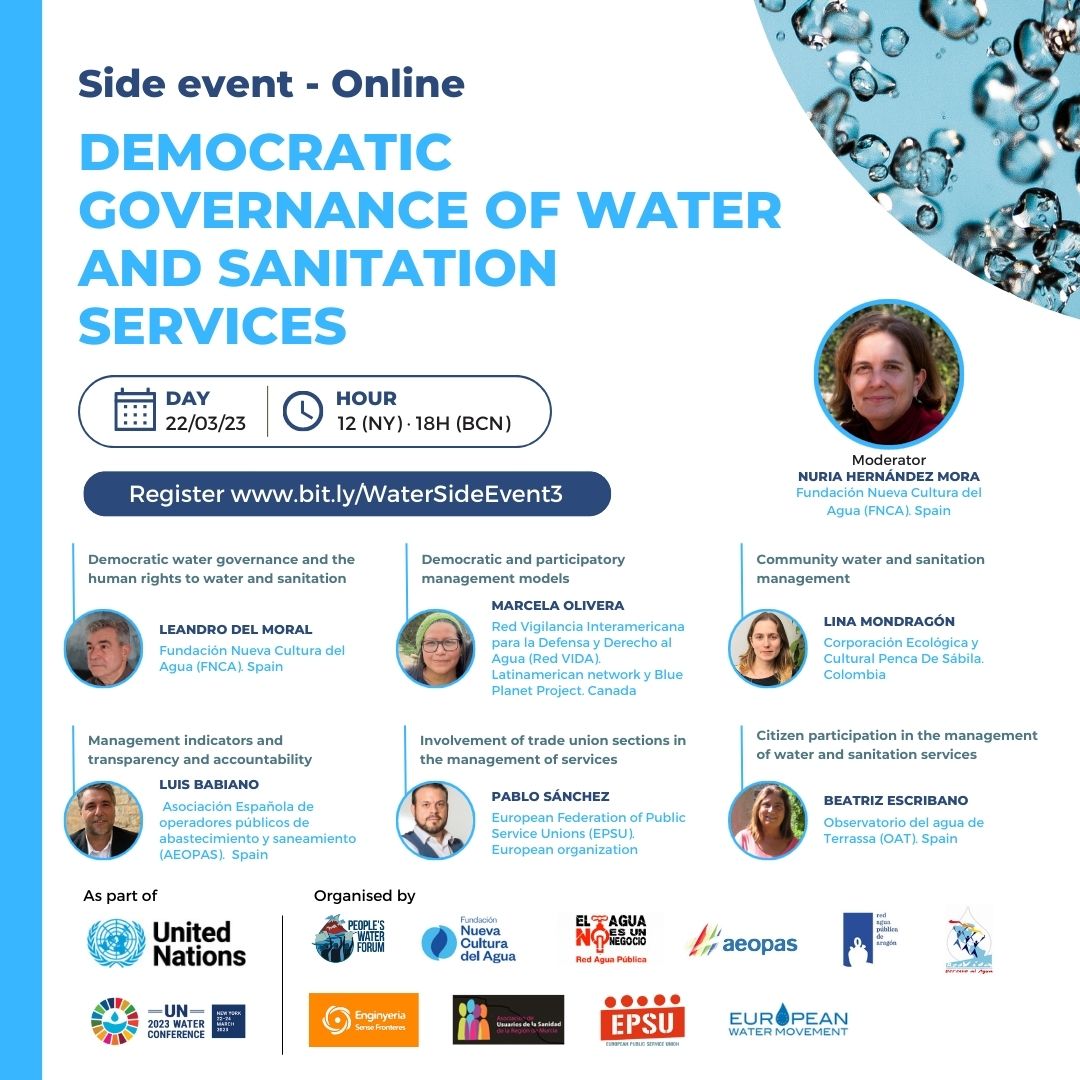
Democratic Governance of Water and Sanitation Services
The side event aims to clarify, in the context of human rights, the scope and content of democratic governance of water in both urban (municipal management) and peri-urban and rural (community management) settings, the importance of transparency and accountability through management indicators and the various possibilities of public participation in the management of water and sanitation services.
Moderator: Nuria Hernández Mora, Fundación Nueva Cultura del Agua. Spain
Speakers:
Organized by:
FNCA, AEOPAS, RED VIDA, EPSU,
RAPA, EWM,
AUSRM and ISF.
Date and time:
22 March 2023
12PM, EST
Register
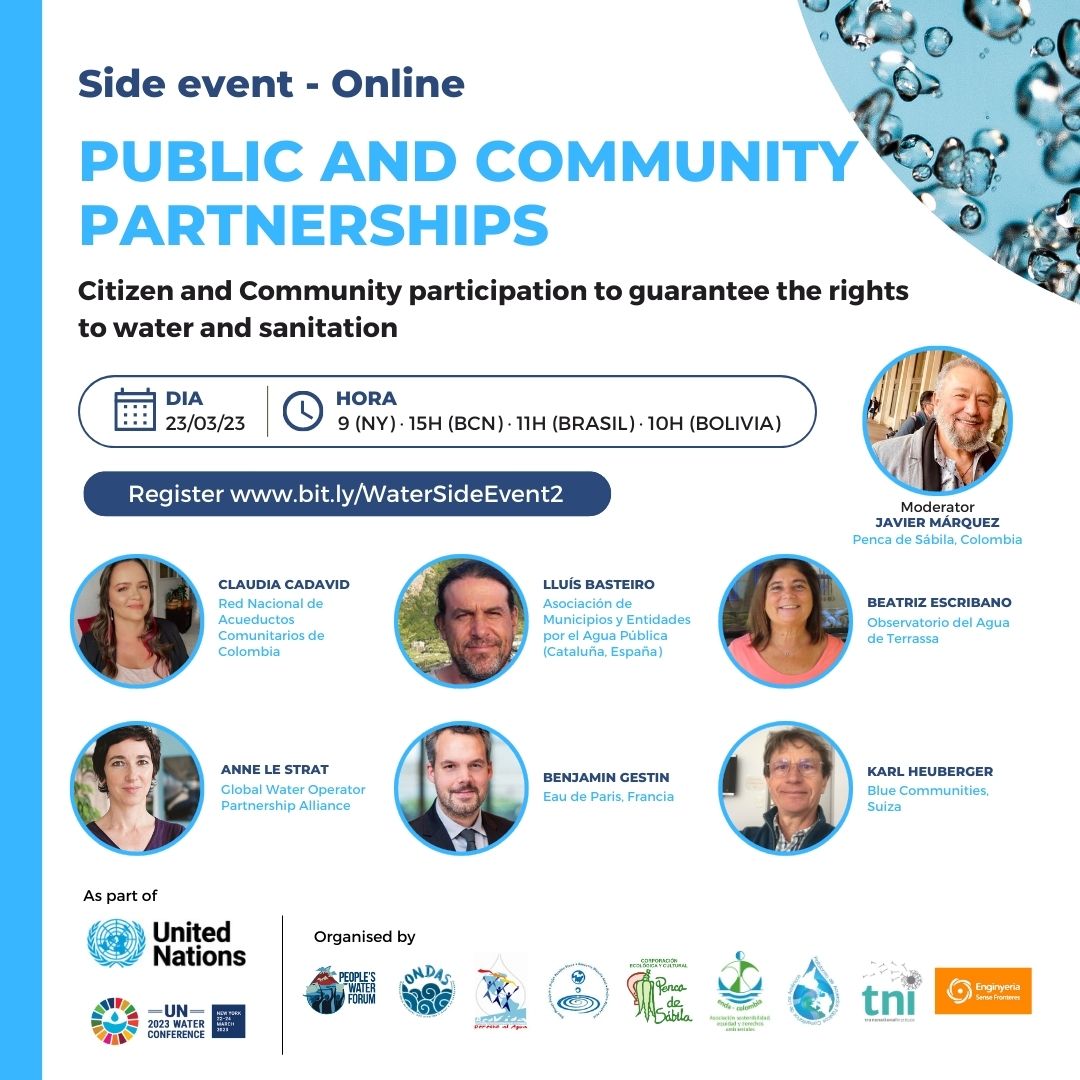
Public and Community Partnerships: Citizen and Community participation to guarantee the right to water and sanitation
Thirteen years after the UN convention on the human right to water, the purpose of this side event is to share and exchange the experiences of citizen and community participation, Public-Community collaborations, partnerships between public organizations and companies, and between organized communities themselves, as creative and proactive forms of water management. These partnerships seek radical changes in decision-making systems based on new social agreements on water, which include the various forms and practices of managing water and involve relationships between social actors based on respect, integration, participation and inter-institutional and community exchange.
This conversation will facilitate dialogue between diverse actors around various forms of collaboration which seek to achieve universal access to water and basic sanitation (SDG 6) through the construction of partnerships to achieve the Sustainable Development Goals (SDG 17). It will emphasize partnerships between organizations, public companies, organized communities and citizen platforms, with the focus on public-public, public-community partnerships and between organized communities that manage water themselves.
Moderator: Javier Marquez, Plataforma de Acuerdos Públicos Comunitarios de Las Américas, PAPC, Colombia
Speakers:
- Claudia Cadavid, Red Nacional de Acueductos Comunitarios de Colombia.
- Lluis Basteiro, Asociación de Municipios y Entidades por el Agua Pública, Cataluña
- Beatriz Escribano, Observatorio de Terrassa, Cataluña
- Anne Le Strat, Global Water Operator Partnership Alliance, GWOPA
- Benjamin Gestin, Eau de Paris, France
- Karl Heuberger, Blue Communities, Switzerland
Organized by:
ONDAS, RED VIDA, BPP,
PENCA DE SABILA, PAPC,
ENDA, TNI and ISF.
Date and time:
23 March 2023
9AM, EST
Register
People’s Water Forum, Affiliated and Recommended Events
 The People's Water Forum